

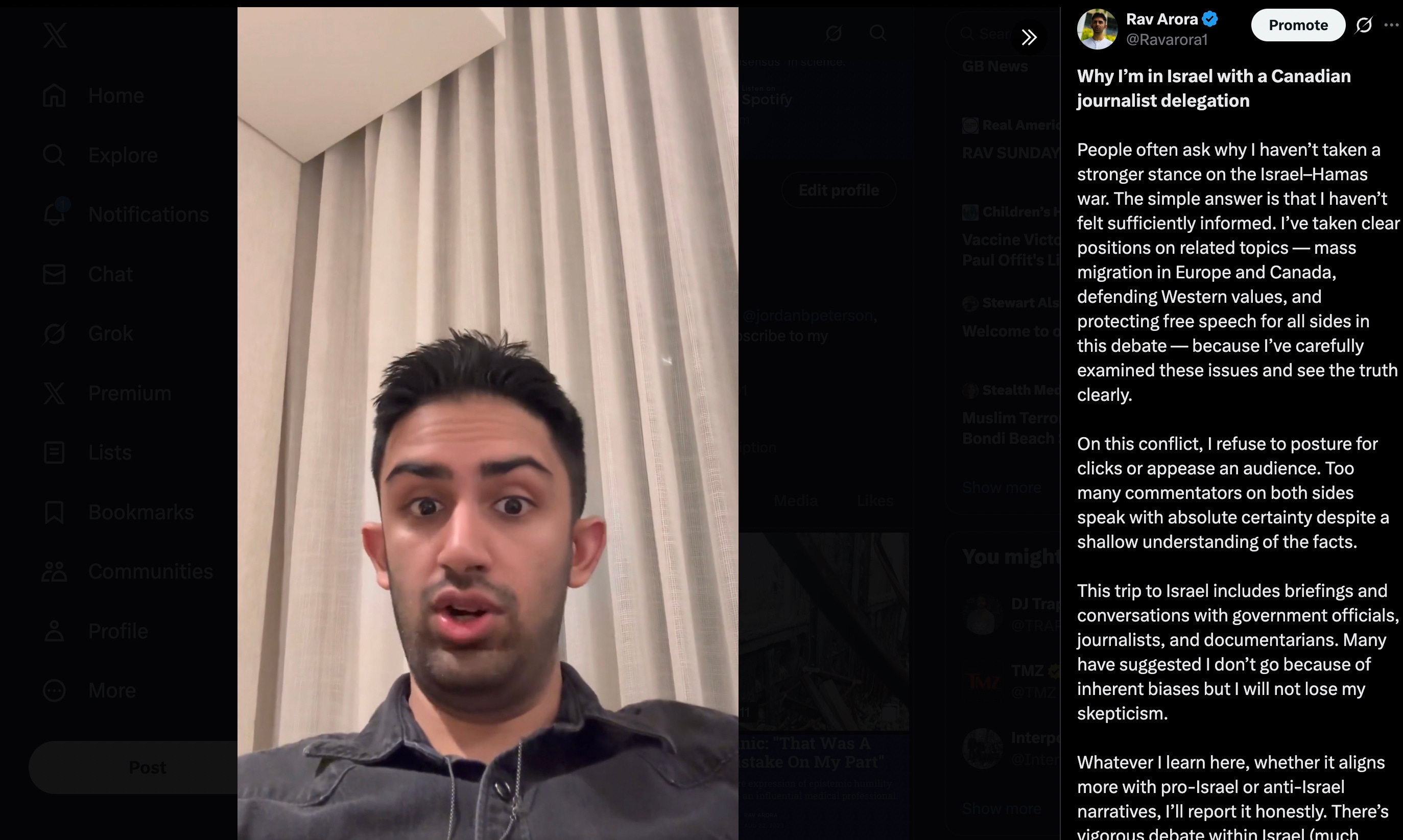
Link to video monologue:
https://x.com/Ravarora1/status/1998514677869928672?s=20
Over the past couple of years, one of the most common questions I’ve received from readers and listeners is deceptively simple:
Why haven’t you taken a strong stance on the Israel–Gaza war?
From one side, I’ve been asked—sometimes politely, sometimes angrily—why I haven’t been a more forceful defender of Israel. From the other, I’ve been questioned about why I haven’t become an advocate for Palestinian rights or statehood.
The honest answer is this: I have not felt sufficiently educated to speak with confidence & clarity about this conflict.
And that answer has bothered some people.
We live in a moment where hot takes are currency and where choosing a side—any side—is often valued more than actually understanding what you’re talking about. I’ve watched countless commentators opine loudly on Israel and Gaza without a meaningful grasp of the history, the geopolitics, or the lived realities on the ground.
I’ve always hated that.
So I came here.
I started my trip in Jerusalem and Tel Aviv and I’m now ending it in Bethlehem and Tubas in the West Bank to get the other side. The purpose of this trip is not activism but journalistic education.
As part of this tour, we’ve been speaking with government officials, journalists, documentarians, activists, and people directly involved in the conflict. I’m listening and asking uncomfortable questions. I’m trying to understand the story beyond slogans and social media graphics.
Anyone who knows me knows I have a high bar for information before I take a public stance. I’m the annoying guy at the back of the room—the one asking skeptical questions when everyone else seems satisfied with dogma. Whether it’s theology, politics, medicine, or ideology, I don’t accept things at face value. I don’t neatly fit into left or right. I don’t outsource my thinking.
That’s why, over the past few years, I have taken strong positions on certain issues—identity politics, free speech, Big Pharma, and the government response to COVID—but only after deeply educating myself on the underlying data, incentives, and power structures involved.
The same standard applies here.
To be clear, I haven’t been silent on everything related to Israel and Palestine. For example, a couple of years ago I publicly opposed calls to ban or censor pro-Palestinian protests in countries like Germany, France, and the Netherlands—calls that were echoed by some conservative politicians in Canada and commentators like Dave Rubin.
Yes, some protests veer into pro-Hamas or explicitly anti-Western territory. That matters. But banning speech wholesale because it’s uncomfortable or threatening to prevailing narratives is fundamentally at odds with the Western commitment to free expression. I was willing to stick my neck out on that principle.
Read here:
Moral Emergencies Are The True Test of One's Commitment to Free Speech

The Illusion of Consensus is a reader-supported publication. To receive exclusive posts and join live Q+As with Rav and Dr. Jay (this Saturday!), consider becoming a paid member:
I’ve also been outspoken about mass migration policies in the West—particularly the failure to have honest conversations about value clashes, including attitudes toward women’s rights, gay rights, free speech, and religious freedom. I’ve argued that Western societies cannot survive if they abandon their foundational values out of fear of being labeled intolerant. I feel confident making those arguments because I’ve studied them carefully.
On Israel–Gaza, I haven’t been there.
I have friends, colleagues, and collaborators on both sides of this issue. I’ve spoken publicly and privately with people like Dave Smith and Glenn Greenwald, and I’ve interviewed and worked with people like Ben Shapiro, Jordan Peterson, and Sam Harris. I respect all of them—even though many of them are despised by large segments of the political spectrum for their views on this conflict.
That alone will trigger some people.
But intellectual honesty requires engaging across disagreement, not retreating into ideological camps. I talk to people I disagree with because I want to sharpen my understanding, not signal virtue.
This trip is part of that process.
I’m here to wrestle with difficult questions: Israel’s response to October 7th. The humanitarian toll in Gaza. The West Bank settlements. Internal Israeli politics. Palestinian governance. International pressure. Moral trade-offs that don’t fit neatly into Instagram captions.
When I finish my trip and arrive home, a few things might happen.
I might feel compelled to take a clearer stance—one way or another—and if I do, I’ll say so plainly. I won’t hedge to appease anyone. Alternatively, I may feel more uncertainty, more unresolved questions, and a deeper appreciation for the complexity of this conflict. If that’s the outcome, I won’t pretend otherwise just to satisfy an audience hungry for certainty.
I don’t believe in ideological black-and-white thinking. I don’t believe in picking a side because it’s fashionable, profitable, or socially convenient. And I don’t believe that silence born of humility is worse than certainty born of ignorance.
I came to Israel to learn.
In the coming days and weeks, I’ll share what I’m seeing, hearing, and grappling with—honestly, imperfectly, and without pretending to have easy answers.
That’s my commitment.
One Small Ask:
The Illusion of Consensus is a fully reader-supported publication. I’ve had to self-fund significant portions of my Middle East travels to places such as Bethlehem and Tubas and could use your support.
If you support the high-quality written and podcast content on this site, consider becoming a paid or founding member to receive exclusive articles, early-access episodes, and ask questions for future episodes.
Or support The Illusion of Consensus with a one-time donation (I had to self-fund around $2,000 out-of-pocket for my trip if anyone would like to donate towards that - happy to give credit or shoutouts in my future work if you’d like. Email me at rav1033@yahoo.ca).
If you're there, it is a very good idea to listen and ask questions with your hosts, and also to spend as much time as possible far away from your host org and seek dissenting viewpoints and other perspectives. I spent a week in Israel with a Israeli gov-aligned group, several days with independent journalists, and another 4 days traveling the West Bank with an organization that documents human rights abuses. The differences I saw were night and day. I highly recommend that if you're there, seek as many alternative viewpoints as possible and do not just stay with a single agenda-driven journalist junket.
If only more journalists had your independent critical thinking! Looking forwards to your evaluation of a 3,000 year old conllict.