


By Matthew W. Johnson, Ph.D., and Rav Arora
One of the noteworthy achievements of this federal administration is finally breaking the taboo on psychedelics and starting to adjust policy to line up with the scientific evidence. In April, the President signed an Executive Order accelerating research and approval of psychedelic therapies. Since then the FDA, NIH, and VA have taken proactive measures to spotlight, fund, and further investigate psychedelic therapies at the federal level.
Psychedelic medicines are on the verge of FDA approval but another question remains afterwards: how should these compounds be classified under federal drug law? The current policy framework that determines the regulation of psychedelics is the Controlled Substances Act (CSA) passed in 1970 which was enacted to regulate certain drugs with abuse potential, classifying them into five schedules (I through V) based on their accepted medical uses, and potential for abuse.
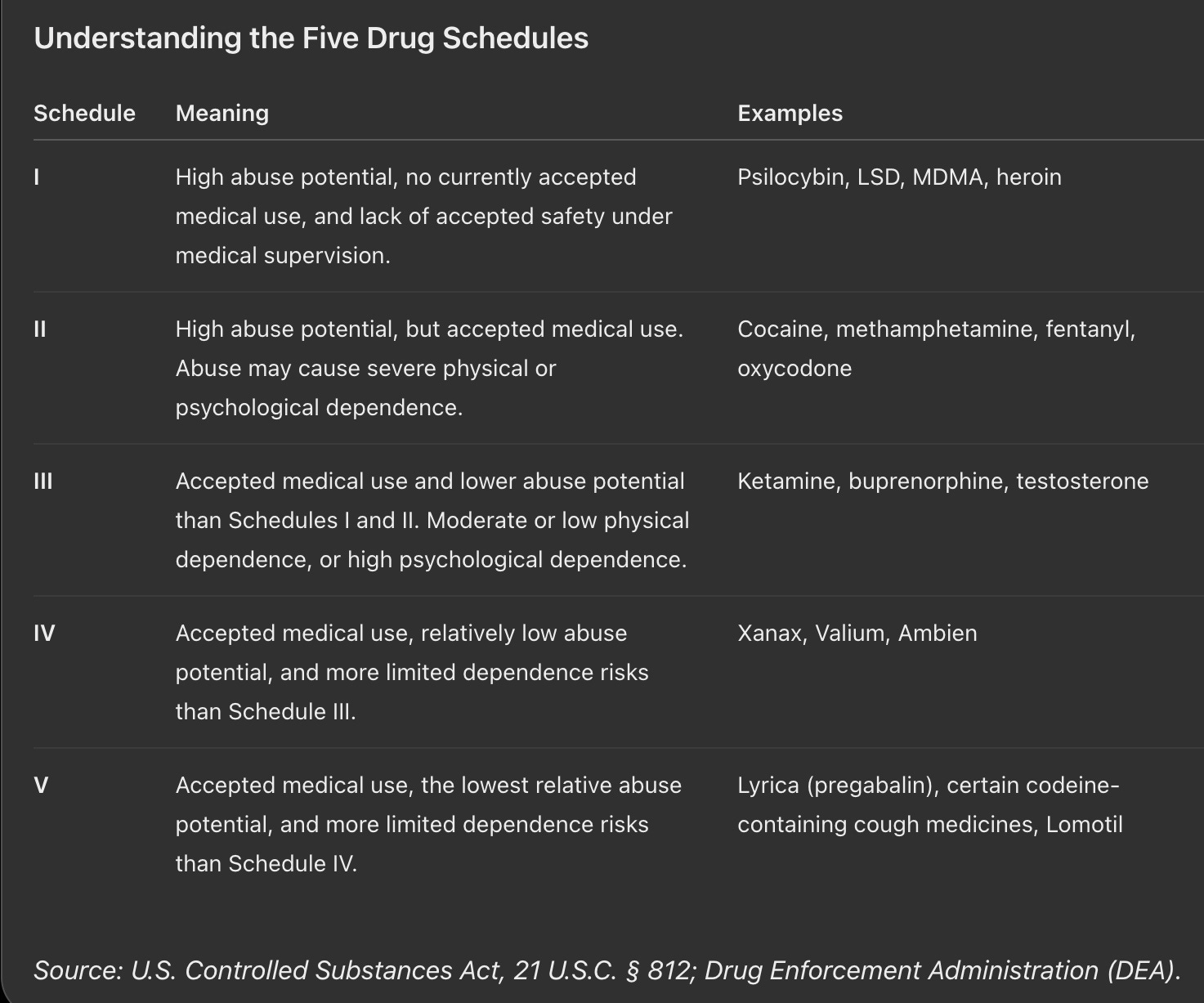
Currently, psilocybin, MDMA, LSD, and other psychedelics are in Schedule I which is reserved for drugs deemed to have no medical utility and high abuse potential. If the FDA approves Compass Pathways’ COMP360 psilocybin, to take a relevant example, the DEA (Drug Enforcement Administration) will be forced to reschedule it. From there, two options exist: either DEA reschedules Compass Pathways’ COMP360 psilocybin formulation as a lower Schedule, like III or IV, and keeps any other source of psilocybin in Schedule I (also known as bifurcated scheduling) or the DEA could reschedule the entire molecule, including psilocin, the active compound into which the body converts psilocybin.
In this piece, we summarize our arguments made in our extensive policy document on why we support rescheduling the entire molecule based on science and policy principles.
One of us (Johnson) has spent over two decades investigating psychedelic treatments for addiction, depression, and cancer-related distress, and has conducted extensive research on the harms of drugs including cocaine, methamphetamine, opioids, tobacco, and alcohol, as well as addiction treatment and abuse liability research. The other, Mr. Arora has spent the past seven years journalistically investigating psychedelic medicine, including on this site The Illusion of Consensus, the newsletter and podcast he co-founded with current National Institutes of Health (NIH) Director Jay Bhattacharya.

Before the 2024 election, we co-authored a psychedelic policy proposal intended for the incoming administration shared by Joe Rogan on X. Then we wrote an updated version specifically tailored to the Trump administration.

The first principle is simple: drug scheduling should reflect a substance’s medical value and risks, not other political or financial interests. Schedule I is reserved for drugs deemed to have no currently accepted medical use in the United States, high abuse potential, and a lack of accepted safety under medical supervision. If the FDA approves psilocybin as a treatment, that approval would establish an accepted medical use for a medicine whose therapeutic effects come from psilocybin itself. Promising research suggests medical potential for psilocybin in treating depression, cancer-related distress, and various forms of addiction including tobacco, alcohol, and cocaine, although depression is the indication for which psilocybin is likely to receive initial approval.
A second consideration is abuse potential. A 2018 scientific review led by Dr. Johnson examined psilocybin under the Controlled Substances Act’s eight-factor framework. It found limited reinforcing effects, no clear physical dependence or withdrawal syndrome, and comparatively low rates of serious harms and problematic use. The authors concluded that, if approved as a medicine, psilocybin would be appropriately placed no more restrictively than Schedule IV. Moreover, as HHS advisor Calley Means stated in his 2021 piece on psychedelics, “For starters, psychedelic compounds aren’t addictive …. Typical drugs from alcohol to heroin to sugar release a dopamine rush, which can lead to addictive behavior.” Means cites a comprehensive 2010 analysis in the Lancet showing MDMA, LSD, and psilocybin mushrooms have the lowest health and community damage score out of all illegal drugs in the U.K:
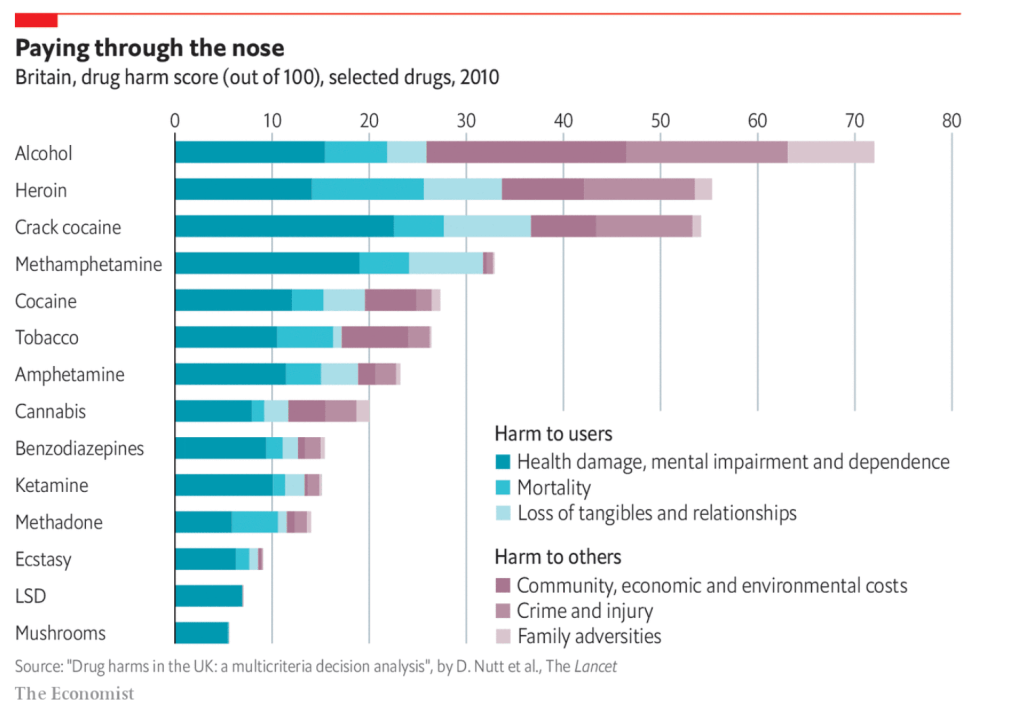
This does not mean psilocybin is harmless. It can cause intense distress, impaired judgment, and serious complications for certain vulnerable patients. Safe medical use requires careful screening and supervision. But its risks are not comparable to the addiction and public health risks associated with drugs such as fentanyl, cocaine, and methamphetamine, which sit in Schedule II. If those drugs can be recognized as having legitimate medical uses without being legal for recreational consumption, why should psilocybin be treated differently?
This classification also affects who can investigate the next generation of medicines.
One of us (Johnson) has conducted human research with psilocybin, cocaine, and methamphetamine. Remarkably, psilocybin has routinely been the most difficult to study—not because it is more addictive or dangerous, but because of the added regulatory burdens of Schedule I. Research authorization, security requirements, and obtaining legal supplies have sometimes delayed studies by six months to more than a year.
Leaving the underlying psilocybin molecule in Schedule I could preserve these obstacles even after a branded psilocybin medicine is approved. Scientists hoping to study other doses, applications, or formulations would continue to face special hurdles. Some institutional pharmacies are reluctant to handle Schedule I materials at all. That means fewer researchers, slower discovery, higher costs, and less competition. We support the companies investing in FDA approval. But a policy meant to promote psychedelic innovation should not inadvertently give the first approved product a regulatory head start over future competitors.
The implications extend beyond pharmaceutical companies. Oregon and Colorado have established state-regulated programs involving supervised psychedelic use. Rescheduling psilocybin would not make those programs automatically lawful under federal law. It would, however, acknowledge the substance’s medical utility and remove Schedule I-specific research restrictions, potentially helping policymakers develop a more coherent framework for those programs.
Critically, rescheduling is not legalization. Moving psilocybin to Schedule III or IV would not make mushrooms available for recreational sale, authorize the prescribing of unapproved psilocybin preparations, or eliminate penalties for unauthorized possession and distribution. Cocaine remains tightly controlled in Schedule II. Similarly, unauthorized possession of alprazolam (Xanax), in Schedule IV, is illegal. A substance can have recognized medical value and still be regulated.
Nor are we arguing that every product containing a molecule must always face identical controls. A formulation that demonstrably changes abuse potential or safety might warrant different treatment, athough the DEA’s authority to do this, or impose bifurcated schedules at all, has been questioned in a 2023 essay by Matthew Zorn, now Deputy General Counsel at the Department of Health and Human Services (HHS)—the DEA offered a formulation-specific rationale in the Marinol case.

But the mere fact that one version is patented or FDA-approved does not, by itself, establish that the identical active substance deserves to remain in Schedule I. And because psilocybin produces essentially all of its psychedelic effects after conversion to psilocin—which also occurs naturally in mushrooms—regulators should evaluate psilocin alongside psilocybin.
Our request is straightforward: if the FDA approves a psychedelic medicine, HHS and the DEA should evaluate whether the underlying active substance also belongs outside Schedule I, applying the same scientific standards used for other drugs. In psilocybin’s case, the evidence makes a strong argument for rescheduling both psilocybin and psilocin, rather than only one company’s formulation.
If a molecule is accepted as medicine, federal drug policy should not pretend that the molecule itself has no medical use.
Read the full policy document here:
Matthew W. Johnson, PhD, conducts psychedelic science at the Medical College of Georgia at Augusta University. From 2004-2024 he led research at Johns Hopkins on psychedelic treatment for tobacco addiction, cancer, depression & safety. He has been interviewed by Lex Fridman, Dr. Andrew Huberman, Big Think & 60 Minutes.
Rav Arora is an independent journalist known for writing in The New York Post, Globe and Mail, and Foreign Policy Magazine. He has appeared in interviews with Jordan Peterson, Sam Harris, Ben Shapiro, Tim Pool and his work has been praised by Joe Rogan and Megyn Kelly on their podcasts.
The Feds can't do anything right! FDA and CDC are corrupt to the core and need to be permanently shut down.
The people of the Land of the Free totally lost their minds when they thought it would be a good idea to give a bunch of unelected career bureaucrats the power to tell us what we can and cannot buy in our local drug store!
The title of your substack, "Illusion of Consensus", is especially apt for this subject, for nowhere it is more clear that the United States drug policy is essentially martial law, a law that is enforced by authoritarians, not consensus of scientific, medical, or democratic jurisprudence. Psychedelic drugs do not fit any of the parameters of Schedule 1. They were placed in that category by declaration of the DEA. The police determine scientific policy. There's a pretense of rationality--the DEA employs an administrative judge--but that's just for show. In every case I know their own judges have recommended Schedule 1 drugs like MDMA, cannabis, be put in a lower schedule, but the cops overruled the docs. The CSA was hastily thrown together by Nixon's thugs when Timothy Leary defended himself in Federal Court against a thirty year conviction for cannabis possession by showing that law against cannabis was unconstitutional. He was right, and so is the Controlled Substance Act, no matter how many weird additions, like "bifurcated scheduling" they make up, it is still a martial law, that serves only the police, organized crime (like the CIA), and money hungry corporations, like MAPS. That law is the main reason why the valuable scientific, medical, recreational, and religious purposes of psychedelics have been squandered for the last half century....