


In my new podcast with Dr. Matt Johnson, I ask him about a remarkable new study examining psilocybin therapy for cocaine addiction:
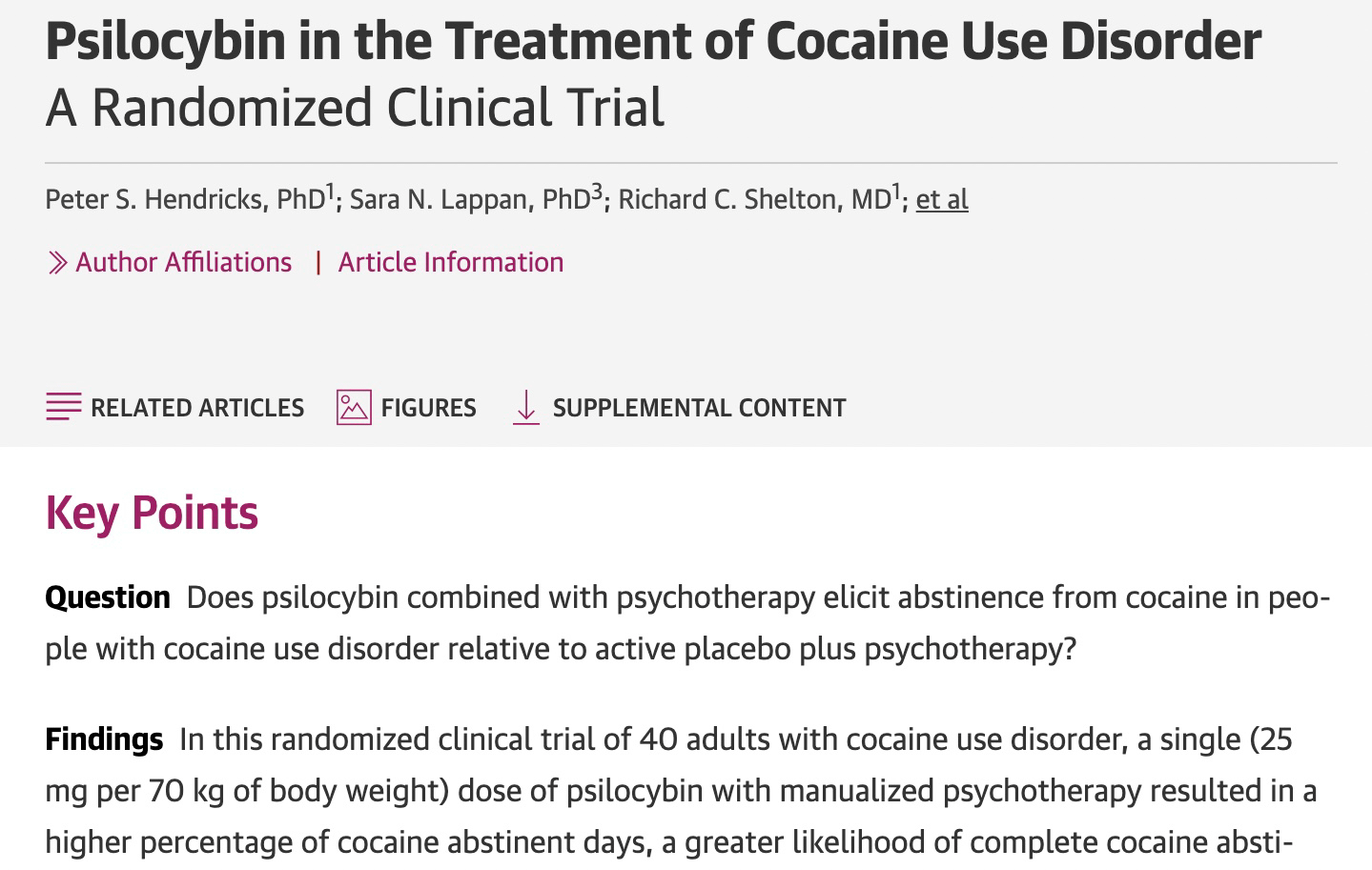
The study, led by Dr. Peter Hendricks & designed by Matt himself, randomized people with cocaine use disorder to either psilocybin or an active placebo, both in the context of psychotherapy. When I asked Matt about the results, he said the effects were “really, really big.”
At six months, the psilocybin group was biologically confirmed to be abstinent from cocaine at extraordinarily high rates — close to 100% in the graph we discussed.
That number is almost hard to believe. It’s a small study, and we need larger replications, but if these findings hold up, this could represent a major breakthrough in addiction treatment.
What makes this study especially fascinating is the population.
This wasn’t a group of upper-middle-class wellness seekers who had read books on shamanism, meditation, or psychedelic spirituality. Matt emphasized that many of the participants were poor, Black, from the Deep South, and making less than $20,000 a year. Many were from the Bible Belt. They were not coming in with the typical positive associations toward psychedelics that you often see in highly educated, white, progressive, psychedelic-curious populations.
And yet, according to Matt, the results were striking.
He also mentioned something that doesn’t show up neatly in the published paper: many participants reportedly had powerful Jesus experiences.
Not New Age “universe” experiences. Not shamanic archetypes.
Jesus.
Matt said Peter Hendricks had described participants having experiences where Jesus “spoke to their heart.” These were often Baptist Christians whose spiritual framework was not psychedelic culture but Christianity. And during these psilocybin sessions, the healing content emerged through that religious language and symbolic world.
That’s one of the most fascinating parts of this whole conversation.
Psychedelics are often framed through a very specific cultural lens: Burning Man, yoga, Eastern spirituality, ayahuasca retreats, shamanism, or secular neuroscience. But this study suggests that the psychedelic experience may express itself through the deepest symbolic and religious architecture of the person undergoing it.
For a secular Westerner, that might be “ego dissolution” or “the interconnected universe.”
For a devout Christian in the Bible Belt, it might be Jesus speaking to the heart.
And clinically, the question is not whether the experience fits neatly into one worldview. The question is whether it helps people change — whether it helps them break destructive patterns, find hope, reconnect with meaning, and stop using a drug that has devastated their lives.
Matt’s broader point is that psilocybin does not seem to work by targeting one specific drug receptor system involved in one specific addiction. It’s not “anti-cocaine medication” in the narrow sense. Instead, the working hypothesis is that psilocybin may work on the psychology of addiction itself.
The compulsive loop. The emotional pain. The loss of agency. The identity of being trapped. The inability to imagine a different life.
That’s why we’re seeing promising signals not only in cocaine addiction, but also in smoking & alcohol use disorder (for most of our recent conversation we focused on Matt’s new study examining psilocybin therapy for smoking addiction).
This is not a magic cure. It requires preparation, support, integration, and serious clinical safeguards. Some people have difficult experiences. Larger studies are needed.
But the implications are enormous.
If psilocybin therapy can help people with severe cocaine addiction — including poor, marginalized people with little prior interest in psychedelics — achieve sustained abstinence, then we may be looking at one of the most important frontiers in addiction treatment.
And the Jesus experiences add another layer: maybe psychedelic therapy doesn’t replace religion or spirituality. Maybe, in some cases, it activates the deepest spiritual language people already carry — and helps them use it to heal.
Watch the full conversation where we discuss this new study (starting at 1 hr 9 min):
Support The Illusion of Consensus!
The Illusion of Consensus is a fully reader-supported publication. If you support the original, fearless journalism on this site, consider becoming a paid or founding member to receive exclusive articles, early-access episodes, and ask questions for future episodes. Or support The Illusion of Consensus with a one-time donation.
Wow wow wow! This is so exciting! I hope it encourages lots of people with cocaine addictions to try this therapy. We need to spread the word. God Bless! X
Ibogaine also works in much the same way:
https://medicalunderground.substack.com/p/ibogaine-a-miraculous-cure-for-addictions